On Making Stuff

For the now several decades of my prior working life I produced results.

These results were just that, something to point to when someone drew a line. As a student, I wrote papers on esoteric subjects such as “non-discontinuous rabbit temporal segments” (I studied philosophy); the deadline was usually the end of a semester. During my time as a non-profit administrator volunteer hours were the measure of success, and by the end of every year we’d aimed to record a few more. As a trader, there was our annual profit and losses to tally and circulate to clients, with the hope that over time we showed more of the former and little of the latter. For nearly thirty years my results were words and figures, all of which over the long haul have as much as evaporated in the memories of the people to whom they were terribly important at the time they were produced, myself included.

At Brooklyn Copper Cookware I’m still writing a bunch, managing hours and ginning up figures, but all of that is in service to this:

Hammersmith by Brooklyn Copper Cookware

Sent by a proud customer upon receiving several of our pots.

Now there’s something tangible at the end of all the scribbling and figuring. With due respect to Dante, at the midpoint of my own divine comedy the path through the dark forest opened onto something real, useful and beautiful.

As a student of philosophy I specialized in aesthetics, specifically aesthetic theory. I was (and still am) very caught up in explanations of beauty, and the splendidly useless experience of it, but over the past many years I’ve come to understand that explanations for things stand quite apart from the things themselves, and are, in a strong sense, superfluous. So often it’s more than enough to let things (and people, for that matter) speak for themselves.

It is also exceedingly pleasant to find myself, on this path at this point, less a student of beauty and more the maker of it. As those who know me best will tell you, the idea that I would ever be involved in bringing into existence anything that speaks for itself, with no need of explanation, was something I kept at arm’s length for a long time.

My dad, not a religious man, was nevertheless fond of quoting Ecclesiastes: “all things good in their time.”

Posted in Entries | Comments Off

An Open Letter to Our Friends and Supporters

(This is excerpted from our first newsletter, sent to subscribers in late June, 2011)

Dear Everyone,

Welcome to our first effort at a little community outreach! Over the past
several months we’ve been contacted by all of you in one or more ways, and
if you’ve ordered from us or checked off that little box on our “Contact”
page, this here’s what you signed up for. Like pretty much everything we’re
doing at the moment, this first newsletter is experimental and we’ll work
out kinks as we go, but for the time being I’d like to ensure that at least
everyone receiving this email wants it. If not, please excuse the intrusion
and follow the link at the bottom of this page to “unsubscribe”. We’ll still
count you as “at the table” even if you’re trying to cut down on spam. :)

The purpose here is to let you know how we’re doing on getting
your orders to you, whether they be for new wares or retinning. As you might
have heard, the NY Times did a lovely little bit on us at the end of March
this year, and the results have had us (happily) scrambling since. Prior to
getting the press’ attention, we tooled along filling an occasional order,
building something like an inventory (of partially completed pots), taking
on a few custom pieces and taking in old pots for reconditioning. As we had
launched only last November, we were still  getting our work-flow down, and
meeting the thousand challenges that beset any new business (more about this
on our blog, and perhaps in a later letter).

By the afternoon of the article’s publication we had sold our entire
“inventory” over 7 times. Suddenly, our thousand smaller challenges were
overshadowed by the giant challenge of making not a few dozen pots and pans
at a time, but hundreds. Additionally, many hundreds of well-loved and
well-worn wares from all over the country began showing up wanting
reconditioning. By the time the wave crested our retinning room had over 300
recent arrivals awaiting attention.

We managed to poach a couple of the guys from Jeff’s bread-and-butter
venture in architectural metal and bring them up to speed on our various
processes. Henry and Gilbert now lathe, rivet and polish on about a
half-time basis, and Jeff and I are still handling the rest. As everybody
slowly gets better we make fewer mistakes and produce the quality level
we’re seeking in less and less time. After two months, some of the first
orders to come in at the end of March have started heading out the door.

To those of you who have received your order, please let us know what you
think! We’ve gotten a few nice notes and photos, some of which I may ask to
put somewhere on the website. In a few cases we’ve sent the wrong lid, had a
rivet or two set incorrectly, or sent an entire order to the wrong address.
Embarrassing, for sure, but I’m honestly surprised slip-ups haven’t happened
more often given that we’re collectively 2.5 guys, one car, a shoebox office
and a cramped 100 year old shop space. However, in the end this is just a
far more popular idea than we’d expected and the onus on us is simple: Up
our game, drop the excuses.

As I’ve noted to some of you (who have maybe gotten one or more of those
excuses), our hope and expectation is that when you open our box your first
thought will be “That was totally worth the wait!”

On the Brooklyn side the Brooklyn and Manhattan Bridges are very close. BCC
is under the Manhattan Bridge and it’s a short walk to one of the best
pizzas in NYC , right under the Brooklyn Bridge; Grimaldi’s. Zagat’s calls
it the best year after year, and I’ve met people there from far and wide on
pizza pilgramages. Every evening the line going out the door portends a
long, hungry wait for dinner – the combo they’re famous for serving, crushed
San Marzano tomatoes, fresh mozz and torn basil. That’s it. The simplest in
the city, done extremely well and totally worth the wait. ;)

Posted in Entries | Leave a comment

Getting a Handle on Made in America

If you’ve read anything of the main Brooklyn Copper Cookware site, it’s probably clear that I was not born, trained nor ever even politely introduced to manufacturing of any sort before I determined that making cookware was somehow a smart career choice for my so-called “second act”. I have the great good fortune of a partner to whom the complexities of raw material sourcing, machine-tool operation and maintenance, labor relations, regulatory tangles and such other of the daily challenges of making actual things are well understood. That’s Jeff, of course, and you can read more about him at the main site too.

When Jeff and I met it was through Harry Rosenblum, the affable owner of Brooklyn Kitchen, the place where I first saw Jeff’s handiwork based on the classic Waldow designs: 14 gauge copper, hand wiped interiors, brass handles. Harry very kindly gave me the only phone number that Jeff ever picks up, which along with dropping Harry’s name got me my audience for the first of the many 1 minute pitches I would have to make in the next couple of years. That one went something like this:

“You know those custom pieces you make for Harry? Whaddaya think about a heavier 2.5mm wall, hand wiped, custom iron handles instead of brass, a mash-up of the pure organic metals with the pure American form? I’ll set up the company and we’ll put American-made copper cookware back at the top where it belongs.”

The negotiations were short and an interesting story in their own right, but what was most compelling at that moment was to see if the old Waldow tooling would stand up to the specification I was talking about. We needed to make some prototypes – the very first Hammersmith pots.

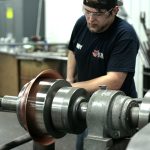
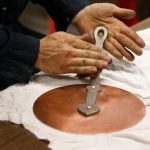
The form of the vessels, or “blanks” as they’re known once they’ve been spun on a lathe from a piece of flat copper sheet (a “penny”) came out beautifully using the heavier stock. Tinning heavier weight blanks is a challenge that took a little re-jiggering of the old Waldow techniques and wasting a few blanks on getting the acids and molten applications tweaked (some of the slightly misshapen pieces that formed the beginning of my personal Hammersmith collection).

And then there were the handles.

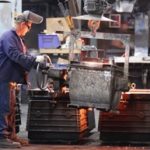
Cast iron has two very desirable qualities for copper cookware. First, it conducts heat slowly, so it stays relatively cool verses the pot it’s attached to (which, as we say, “Gets Hot Fast”). Second, its coefficient of expansion (meaning the rate at which it expands and contracts as a function of energy going into and out of it) is very similar to copper, despite the two metals vastly different thermal conductivities. This means there’s less stress on the joint between handle and pot. I naively thought that getting the appropriate castings would be no more difficult than, say, stumbling upon the country’s last spinner of legacy copper designs in my own backyard.

We spent a tidy chunk of startup capital shattering test castings as we riveted them to their pots. The examples we were getting were simply being smelted and tempered too hard. Not being metallurgists we could describe the application to to a potential vendor, and assumed they’d figure out the formulation and tempering requirements. This, as it turns out, is a far more delicate balancing act than one might guess – hard enough to not crack under the load of a full stock pot, but ductile enough to form to that stock pot’s side under the riveting hammer without deforming the relatively soft copper wall.

The pain-staking solution that Jeff came up with was to measure the curve of the pot a handle was to be fitted to, and then hand grind the face plate of each handle to that curve before riveting. This was an OK solution while prototyping, but it was threatening to make the iron scraped off the unseen part of every pot’s handle a huge part of each pot’s cost.

The upshot: Finding a casting shop to formulate and temper what is called ductile iron to ever so slightly yield to the varying curves of a bunch of different copper pots is a manufacturing discipline it is now very hard to find in this country. We’re still looking. In the meantime, hand grinding handle face plates is how we’re getting along, and Jeff grouses with some justification that one of the beauties of the old brass handles was that they flexed home to form a tight joint as the rivets were applied.

True enough, but iron is how copper cookware was equipped for thousands of years, it’s how our competitors in France do it today and what getting it right amounts to is a little metallurgical trick we just have to root around and find again on the highly fragmented American manufacturing landscape. When the US did a lot of the kind of work we’re doing, specialized iron fittings could be found all over in all sorts of hardnesses, especially in Brooklyn, where a great many of the major architectural components for the iron facades in lower Manhattan or Newark’s “Ironbound” district originated.

I learned very quickly that I could get the right handles made in Romania, perfectly tempered and tumble finished in quantity, FOB at JFK Airport, for less than we were paying to have not-quite-right castings made in Pennsylvania. Someone else might call that a solution to the business problem (and maybe the French and Belgians do), and since we’d still be assembling in Bushwick we’d be able to say our pots are “Made in America”, but then we’re getting away with something we think is symptomatic of a larger problem, which can be summed up with the (rhetorical) question: “Does anybody deliver what they promise anymore?”

As far as making anything in the US these days is concerned, it’s our experience over the past couple of years that, while it’s possible to deliver on promises, it’s very tricky to promise an truly American made product anymore. Ask Dean and DeLuca. They recently came out with a beautiful line of hand-made copper cookware that they are selling under their own boldly stamped private label. It’s brilliant, both as cookware and as a business maneuver, and I respect D&D for being first out of the gate with most of the ideas that have changed the food world in the US since their founding in the early 1970s. Their wares are designed by Amoretti in Italy, the same folks who do work for Ruffoni.

The pots themselves, however, are a little more quietly noted as being made in Mexico. Lot’s of good copper in Mexico (same veins that come into New Mexico and Arizona, where we source our stuff), lots of skilled smiths, and the Mexicans have kept those old-time skills alive such that their genius shows up on the shelves of top-flight retailers as something the purveyors are proud to put their name to, and for which a living wage is paid in Sonora. D&D is selling their pots for a lot more than we’re selling ours, for which living wages are paid in New York City.

Maybe some of you remember when Ford tried passing off their Merkur as some sort of European high-performance confection, or GM hung tags like Eurosport 6000 on their garden-variety Pontiacs. There’s a lot that we have to get over as a culture (and as an economy) for the cache of “American-made” to not be merely a reaction to the rise of other economic powers, such as China today, but as worthy in its own right because American-made is simply the best you can get anywhere.

To us, then, it’s critically important that our Brooklyn imprimatur also be trust-worthy, that when we say our goods are made in this country that they are not merely assembled here, that their quality inheres in their authentic abilities and execution, not in the conceit of a red, white and blue sticker or shallow jingoisms, that every bit of what you’re buying from Brooklyn Copper Cookware originated with the remaining American ability to make things, things people need and that are worth having, and are worth paying for.

Yes, it takes us longer than it should to make something as simple and elemental as a cooking pot, even by hand, but we’re getting it figured out; literally and figuratively getting a handle on it.

Posted in Entries | Leave a comment

Brooklyn Copper Cookware: Out of the Pan and into the Fire

Blanks and Pennies

Off to a Good Start

On November 7th, 2010 my life changed profoundly. It could not have happened with lesspomp or circumstance; it came to pass (like so much radical change these days) with the pushing of a button. From one second to the next the Brooklyn Copper Cookware website I’d spent months imagining was suddenly organized enough to pronounce itself an actual destination, so with a single click my doors swung open for business, and I promptly went to bed.

The drama had been in the lead up – a couple of years of:

Wildly optimistic expectations (mostly in my own ability to understand what it was I was getting into);

Planning as a pleasant notion rather than as, you know, something being done and followed;

The falling-into-place of everyone and everything, if not right when they were thought-of or needed, but eventually and always to brilliant effect;

Punishing tutorials on how little the axioms by which I thought I had lived my life for 46 years had ever actually been tested (especially my old favorite “Risk everything all the time);

The ineffable feeling in a moment when a simple vision is transformed into a useful artifact, and thus into meaningful work, work that seems much less like what I’ve called work in the past. Work that brings me into daily contact with people of a constitution similar to my own, be they liberal or conservative, widely traveled or locally learned, formally educated or masterfully applied, chefs, fond home cooks, aesthetes or tool fetishists… what they and I share is a finely wrought enthusiasm for simplicity and elegance and performance perfected thousands of years ago that doesn’t need me nor anyone else to promote it. This is my new community.

People who use copper cookware already know something special – about themselves and about the tool. Using copper means taking responsibility for one’s cooking, because unlike other more recent developments in the Batterie de Cuisine copper does exactly what it is told to do, exactly when it’s told to do it. The cook is in complete control, and when things fall apart (as inevitably they do in any art), a good copper pot will never be what gets blamed for the failure.

Me, I love using copper for all the reasons above and more – some of which I hope will come out as I muse in this forum. What I hadn’t thought of (going into it) is that it wouldn’t be just me who’d be passionate about the launch of this business. People who had resigned themselves to “Made in the USA” being equated with credit swap derivatives and genetically modified microwave popcorn are applauding the resurrection of a primary technology, a basic tool from mankind’s first metal age, made again in scruffy, can-do Bushwick; pretty low on most New York tourists’ itineraries, but the one place in the country to find the last word in fine, hand-made tools for outfitting your kitchen and fully harnessing your abilities.

And, at the risk of blowing the horn a bit too loudly – all this was done over the last two years without a single taxpayer’s dollar, without a penny of the enormous capital pile banks were encouraged to lend to small businesses (and didn’t), with no incentives, breaks or handouts of any kind. We did it with the help of family, friends and our own savings, and very importantly the faith of a few early customers (who somehow found us while our website was still a scattered tangle on my designer’s servers), their willingness to pay in advance and then to wait weeks for our first pieces to come over the finish line. To all of you I owe much of the pleasure I’m taking in these wobbly first steps.

So, while the doors didn’t open with a bang, that’s probably just as well. Revolutions that proceed quietly often effect the their changes before anyone knows anything has happened.

Posted in Entries | Leave a comment